









Foamboard vs. PVC vs. Gatorboard: Which Sign Material Should You Choose?

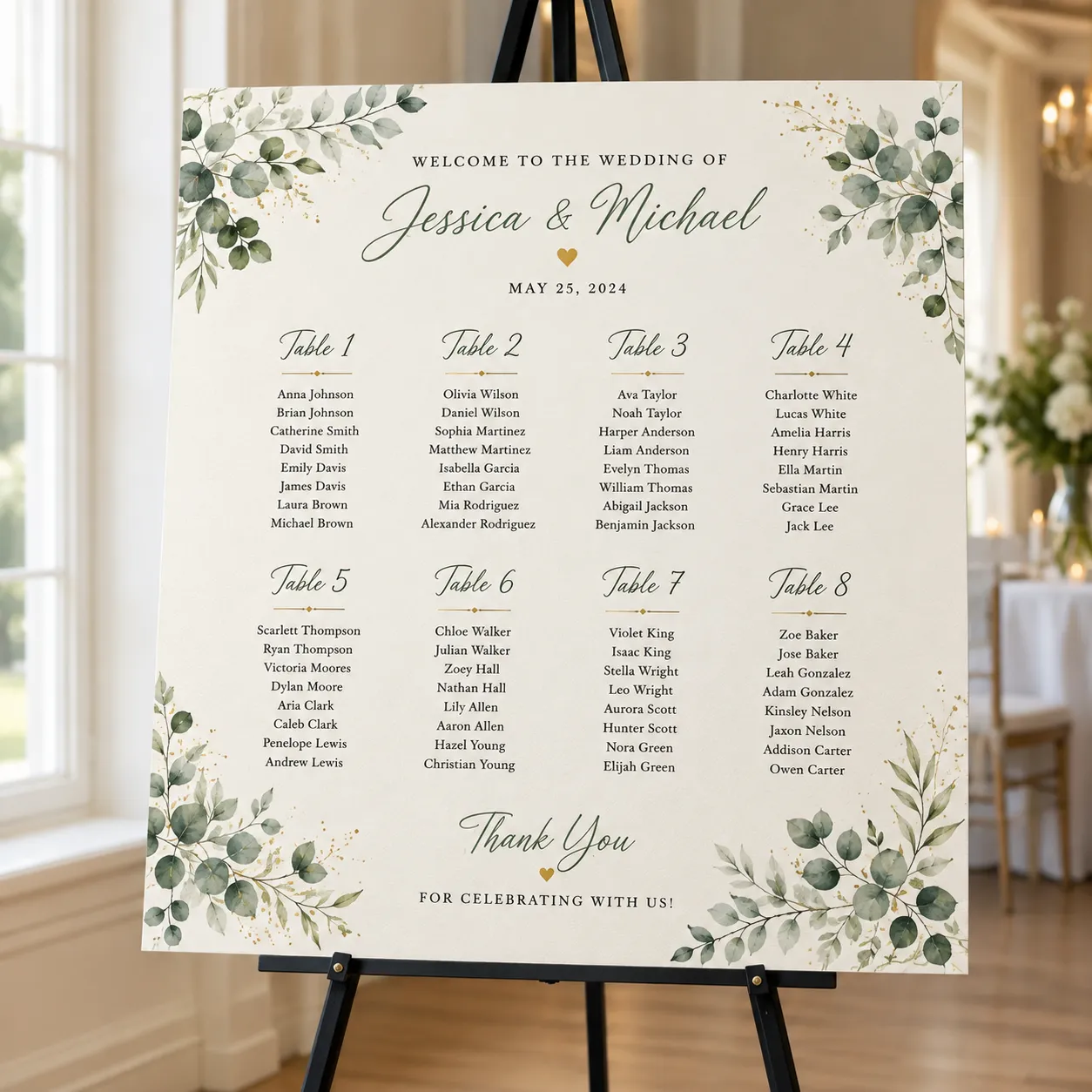
A sign can look excellent on screen and still be the wrong fit for its location. A lightweight event board, a frequently handled retail panel and an outdoor directional sign place different demands on the material behind the print.
Start with the setting and how the sign will be supported. Foamboard is a practical starting point for temporary indoor displays. PVC is a plastic panel worth considering when moisture resistance matters. Gatorboard offers a more rigid foam-board construction for substantial indoor presentations. The right choice also depends on dimensions, thickness, handling and finishing.
Watch the 32-second guide
Have a project in mind? Request a custom printing quote or call (323) 549-9444.
Quick visual guide
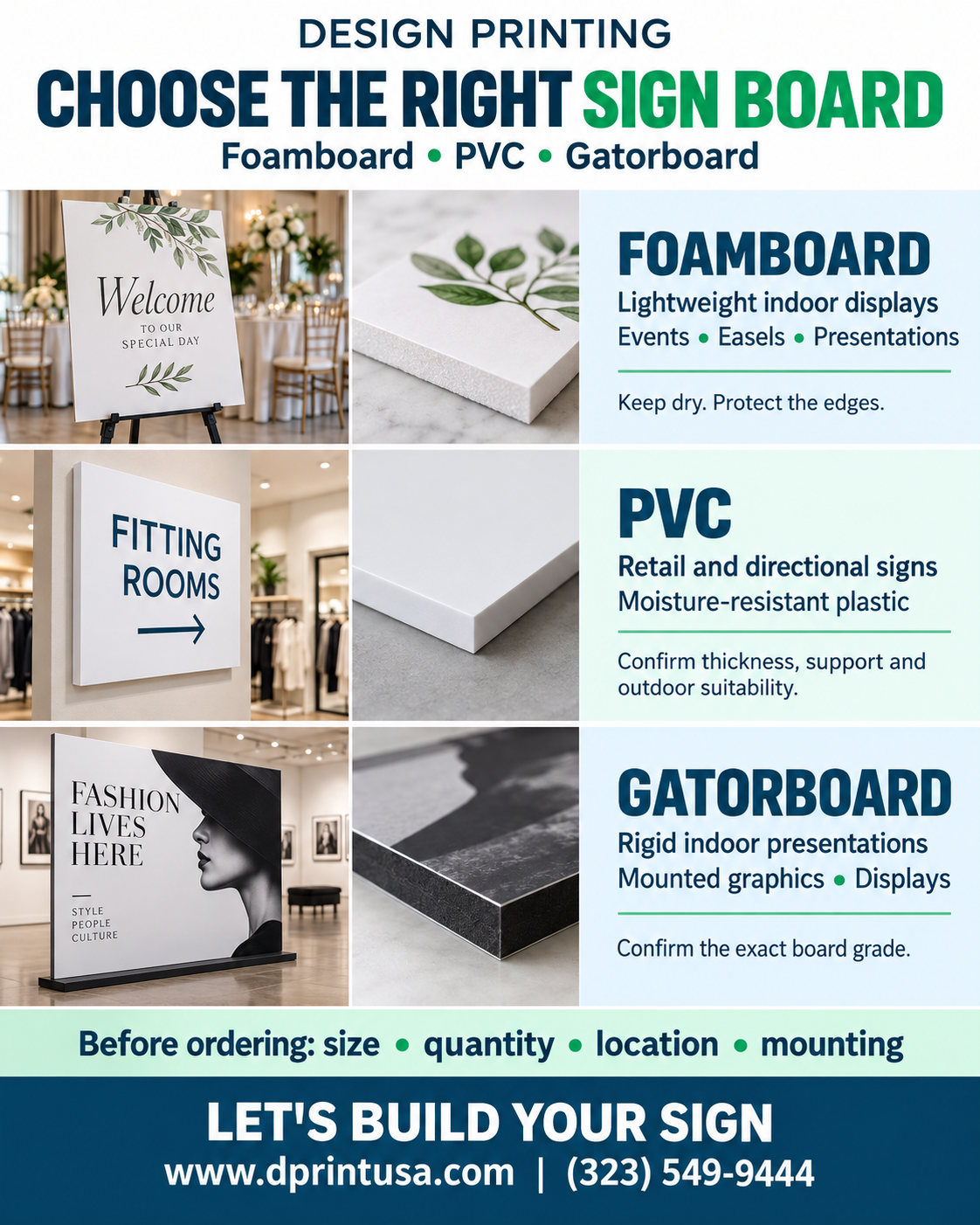
A quick comparison of the three materials
| Material | A useful starting point for | What to confirm |
|---|---|---|
| Foamboard | Indoor event signs, presentations and easel displays | Protection from moisture, edge damage and repeated handling |
| PVC | Retail panels, directional graphics and applications needing a plastic substrate | Thickness, support, exposure and suitability of the exact grade |
| Gatorboard / Gatorfoam | Rigid indoor displays, mounted graphics and presentation panels | Board grade, handling, mounting and any proposed outdoor use |
This table is a project-planning guide. It does not mean that every thickness or brand within a material family performs identically.
When foamboard makes sense
Foam board signs combine a foam center with paper faces. Their low weight makes them convenient for an indoor welcome sign, a meeting presentation or a promotion displayed on an easel. Design Printing lists 3/16-inch and 1/2-inch options for this product.
Consider how the sign will travel as well as where it will stand. A board that is carried in and out of a vehicle, leaned against walls or stored without corner protection can collect visible damage. For a one-day indoor event, light weight may be the priority. For a display used at many events, ask whether a different substrate and protective packing would be a better investment.
Standard paper-faced foamboard belongs in a dry indoor setting. The manufacturer describes FOME-COR paper-faced board as a material for short-term interior displays. A printed or laminated surface should not be treated as proof that the entire board is waterproof.
When to consider PVC
PVC signs use a plastic substrate rather than paper-faced foamboard. The product currently listed by Design Printing is a 3 mm panel with a low-glare finish. It is an option to discuss for retail graphics, directional panels and signs that need a different balance of weight, surface finish and moisture resistance.
For an exterior installation, give the printer the full project details before choosing a sheet. Outdoor suitability depends on the actual product grade, panel thickness, dimensions, support and exposure. For example, 3A Composites recommends specific thicker gauges for exterior SINTRA applications. That guidance is a reason to verify the proposed material, not to assume every thin PVC panel suits every outdoor location.
When Gatorboard is the better conversation
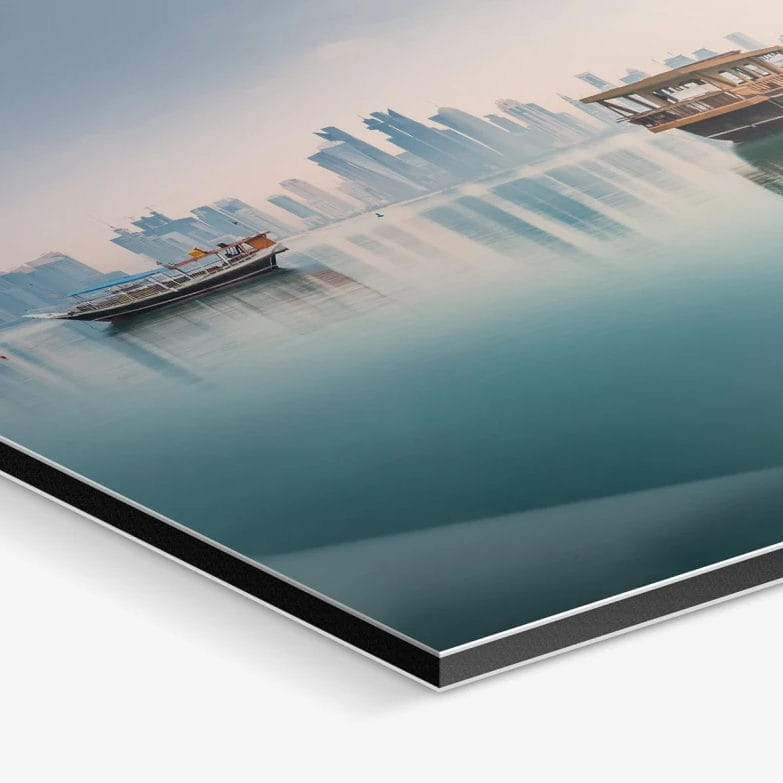
Gatorfoam board uses a foam core with wood-fiber veneer faces. Customers often use “Gatorboard” to describe this type of rigid display board. It is worth considering when an indoor presentation needs more structure than ordinary paper-faced foamboard, especially when the edges or thickness will be visible.
The manufacturer identifies standard GATORFOAM with mounting and interior display applications. Exterior variants have also existed, so ask which grade is being quoted before approving outdoor use. A familiar material name alone is not an outdoor specification.
Thickness, mounting and finishing change the result
Choose the material and mounting method together. A sign sitting in an easel, a panel attached to a wall and a suspended display have different support requirements. Send a photo of the location and describe the hardware already available. A larger sign may need a different construction from a small panel, even when the artwork is the same.
- Finished dimensions: Provide width and height, and say whether the measurement includes a frame.
- Visible edges: Decide whether a square edge, rounded corner or custom contour suits the design.
- Attachment: Identify planned holes, fixtures or supports before the artwork is finalized.
- Surface finish: Discuss glare, handling and whether a compatible protective finish is useful.
- Reuse: Explain how often the sign will move and how it will be packed and stored.
Prepare artwork for the finished sign
Build the design around the viewing distance. A directional panel should communicate its main message quickly; a sign read up close can carry more detail. Keep logos, phone numbers and essential text clear of mounting holes, trim edges and hardware.
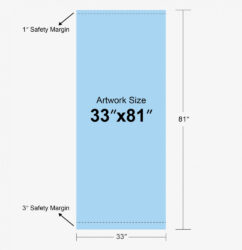
For a custom shape, ask how the printer wants the vector cut path supplied. Keep the cutting instruction separate from the printed graphic so it is not mistaken for artwork. Use the selected product template for bleed, safe areas, color setup and resolution. Our guide to bleed, trim and safe areas explains the terms, but the production template determines the actual measurements.
Frequently asked questions
Is Gatorboard the same as ordinary foamboard?
Both have a foam core, but their faces differ. Ordinary paper-faced foamboard and Gatorfoam’s wood-fiber-faced construction should not be treated as interchangeable when quoting rigidity, finishing or application suitability.
Can I use a laminated foamboard sign outside?
Do not assume that lamination makes paper-faced foamboard suitable outdoors. Tell the printer about rain, moisture and exposure so the full construction can be assessed.
Which material should I request if I am unsure?
Describe the application first: indoor or outdoor, sign dimensions, mounting method, handling and how long it will be used. Ask for a material recommendation and, when appearance is critical, a sample before approving the order.
Request a rigid sign quote in Los Angeles
Send Design Printing your dimensions, quantity, artwork, installation photo and required delivery date. Include whether the sign is temporary or reusable, and any preferences for thickness, cutting or mounting. Those details help us quote a sign that fits the job.
Prefer to discuss the project? Call (323) 549-9444.


